
Sentinel

Sentinel · interface layer
Sentinel
The interface into the governed operating system.
Sentinel is the contextual command layer for route state, evidence, topology, governance, simulation, and safe next steps.
Sentinel
Sentinel · interface layer
The problem
Generic AI chat loses operational context. Operators need an interface that knows what page they are on, what evidence exists, and what action is governed.
You want operators to ask the system what matters without giving it unsafe control.
You are replacing generic chatbots with a governed interface that knows your routes.
You need an AI layer that explains posture, evidence, and policy before suggesting moves.
Why businesses choose Sentinel

One interface into the OS
Give operators a single, contextual agent that speaks the language of your surfaces.

Grounded in real posture
Every answer is tied to route state, evidence, topology, and policy visibility.

Simulation before action
Sentinel routes to inspect, review, or simulate instead of launching opaque commands.
Sentinel sits on top of the entire operating system, turning every route and agent into a governed, explainable interface.
Connects to
- Command center
- Runtime context
- Evidence packs
- Topology
- Approval paths
How it works
- 1Context
- 2Evidence
- 3Simulation
- 4Governance
- 5Safe route
Contextual guidance
Sentinel explains what it sees in the current surface and why it matters.
Runtime grounding
Recommendations are tied to live route posture, evidence, topology, and governance state.
Safe command layer
Guidance routes to inspect, review, simulate, or open evidence rather than executing hidden actions.
Evidence posture
Logged-out preview only; tenant evidence loads after sign-in.
Outcome
Operators can ask what matters, understand why, and navigate to a safe inspection or review path.
Signal source
Route + runtime stateSentinel declares what context is available and where evidence is pending.
Policy state
Action heldNo send, publish, approve, reconnect, launch, or mutation is exposed from public pages.
Simulation source
View-only impactWhat-if previews are explanatory and do not change downstream state.
- Action safety
- Policy visibility
- Context provenance
- Simulation-first routing
Evidence rail
Open the console to inspect tenant-scoped evidence for Sentinel.
Open evidence in console →Related agents
SENTINEL
Agent profile →SENTINEL
Gateway for POST /interactions: validates payload, attaches trace context, and hands off to ATLAS + policy.
Operator console (Next.js)
Agent profile →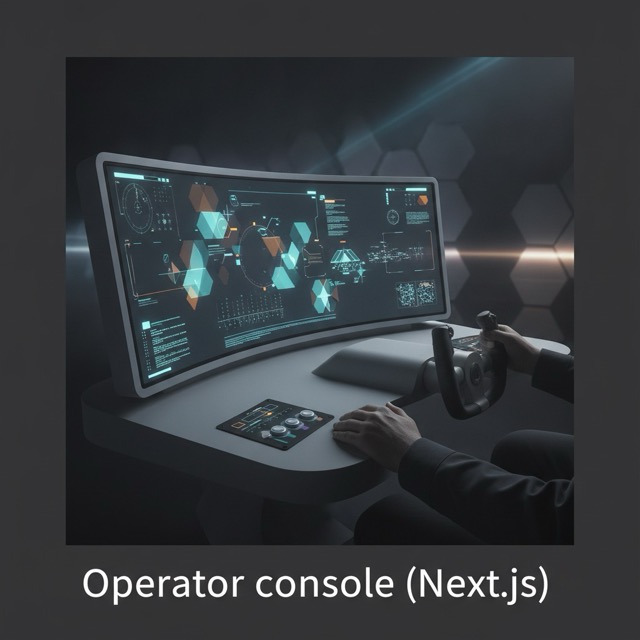
Operator console (Next.js)
Primary control-plane experience for pilots and demos; uses cookie-based JWT to `/api/v1/*` (see `apps/web/middleware.ts`).
Marketing OS (MERCURY module surface)
Product story →
Marketing OS (MERCURY module surface)
Primary operator workspace for governed marketing operations; MERCURY domain agent manifests in integration topology.
Sales OS (AUCTOR module surface)
Product story →
Sales OS (AUCTOR module surface)
Primary operator workspace for governed sales and pipeline intelligence; AUCTOR domain agent manifests in integration topology.
Growth Command Center
Product story →
Growth Command Center
Single pane for demand-to-revenue posture when one or both commercial modules are active.
API ingress & identity boundary
Agent profile →
API ingress & identity boundary
Single controlled ingress for the TypeScript kernel; aligns with API-first posture.